In American home culture, DIY home renovation is not just a cost-saving option, but also a way to showcase personality and taste. The modern style, known for its simplicity, functionality, and sense of design, is perfectly suited for realization through DIY. This article will provide you with modern DIY renovation plans suitable for American homes, covering entry-level projects, material selection, tips sharing, and localized resources to help you easily create a stylish living space.
Entry-Level Modern DIY Projects: Easy for Beginners
The core of modern renovation is “less is more”, and you can achieve a quality upgrade without complex craftsmanship. Wall decoration is the most cost-effective starting point. For example, create an accent wall with 3D geometric wall stickers – choose matte black or light gray PU material stickers (available at Home Depot or Amazon) and arrange them symmetrically or in a gradient to instantly enhance the modern feel of the space. For renters, removable vinyl stickers can be used instead to avoid damaging the walls.
Furniture transformation is another major direction. Transform an old wooden table into a modern side table in just three steps: sand the surface until smooth, apply matte white or dark gray water-based paint (Behr’s zero-VOC series is recommended for its environmental friendliness and strong coverage), and after drying, add brass-colored metal table legs (available at Lowe’s, priced at approximately $8-15 each). This combination of “light color + metal” perfectly fits the principle of material collision in modern aesthetics.
Lighting upgrades can quickly change the atmosphere. Make an industrial-style chandelier with PVC pipes and Edison bulbs: cut 4 30cm-long PVC pipes, spray them with black matte paint, fix them in a rectangular frame, hang a vintage bulb in the middle, and match it with a black fabric lampshade. It is suitable for installation in the dining room, with a total cost of no more than $50.
Modern Style Material Selection: Adapting to Local Procurement and Climate in the US
Climate varies greatly across the United States, so material selection needs to be tailored to local conditions. In terms of basic materials, reclaimed pine is suitable for dry areas (such as the Southwest). It is inexpensive and has its own texture, and can be used for bookshelves or wall partitions; composite solid wood is more moisture-resistant, suitable for the southeast coast, and Lowe’s Pressure-Treated series offers outstanding cost performance.
Among decorative elements, metal is the soul of modern style. Brass accessories (handles, hooks) are suitable for warm-toned spaces, while matte black metal (brackets, picture frames) are suitable for cool-toned spaces, both of which can be purchased in bulk in the Hardware section of Home Depot. For glass elements, Tempered Glass is recommended for its high safety. It can be cut into table tops or partitions, and local glass workshops (such as Glass Doctor) provide customization services at a price 30% lower than finished products.
Eco-friendly materials are very popular in the US DIY market. Recycled polyester fiber carpets (Stainmaster’s Eco-Friendly series) are suitable for living rooms, as they are stain-resistant and easy to clean; bamboo floor stickers (peel-and-stick type) are easy to install and suitable for kitchen renovation, and are often on sale in Target’s Home department.
Colors and Matching: The Visual Code of Modern Style
The color scheme of modern style follows the “60-30-10” rule: 60% base color, 30% secondary color, and 10% accent color. The base color is mainly neutral. For walls, Benjamin Moore’s “Classic Gray” (OC-23) or “Metropolitan AF-690” are recommended. These colors maintain their texture under different lighting conditions and are “universal colors” commonly used by American designers.
Secondary colors are used to balance the spatial hierarchy. A light gray sofa with dark gray curtains, or off-white walls with 原木色 furniture, form a gentle transition; if you want to add vitality, you can add cushions in Morandi colors (such as Sage Green, Dusty Blue). H&M Home’s cushion covers are cost-effective, with geometric lines or abstract textures in their patterns.
Accent colors are the finishing touch. In an all-white space, 1-2 bright yellow items (such as a single chair, floor lamp) can break the monotony; in a gray-toned space, olive green plants (monstera, fiddle-leaf fig) can be added, which are fresh and natural. IKEA’s FÖRENLIG series flower pots have a simple design and perfectly integrate with the modern style.
Material collision can enhance the sense of hierarchy: marble-patterned stickers (imitating Calacatta quartz) are pasted on the surface of the dining table, paired with black metal chairs; rattan baskets are placed on wool carpets, forming a contrast between softness and hardness. These combinations not only conform to modern aesthetics but also reflect the ingenuity of DIY.
Money-Saving and Efficient Tips: Practical Experience from American DIYers
Tool sharing reduces initial investment. Many American communities have Tool Libraries (such as Chicago Tool Library), where you can rent sanders, electric drills and other large tools for free, with only a deposit required; Facebook Marketplace often has people reselling second-hand tools, and 90% new Black & Decker electric drill sets are only half the price of new ones.
There are two main ways to save money on materials: pay attention to seasonal promotions. Every January and July is Home Depot’s inventory clearance period, with discounts of up to 40% on paints and tiles; join local building material recycling groups (such as Nextdoor’s Free Stuff section), where you can often get free leftover wood and tiles from demolition, which can be used after a little processing.
In terms of time planning, it is recommended to adopt the “zone-by-zone progressive method”. First complete the projects with strong visual impact (such as walls, entrances), then handle the details (such as lamps, soft furnishings) to avoid chaos caused by simultaneous construction in the entire house. Purchase materials intensively on weekends, and spend 2-3 hours on small projects (such as changing handles, pasting wallpaper) on weekdays. A 30㎡ living room renovation can be completed within 3 weeks.
Case Reference: DIY Modern Style Renovation of Ordinary American Families
Small living room (about 25㎡): Owner Lisa replaced the original floral wallpaper with light gray latex paint (Sherwin-Williams’ Agreeable Gray), used IKEA’s KALLAX bookshelf as a partition, pasted black wood grain stickers on the outside, and installed LED light strips on the inside. The old sofa cover was replaced with dark gray linen cloth, paired with 3 ginger yellow cushions, with a total cost of $650, and the space visually expanded by 20%.
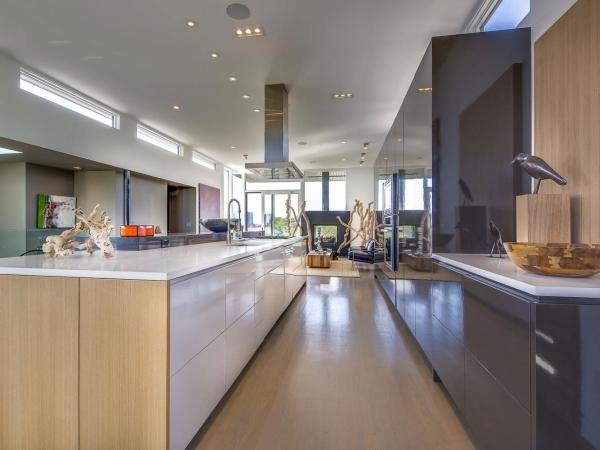
Open kitchen: California owner Mike retained the original cabinet frame, replaced the cabinet doors with white matte panels (customized by Lowe’s), and added black long strip handles. The countertop is covered with 3mm thick quartz stone stickers, paired with stainless steel shelves, and 4 black iron chandeliers are hung. It cost $800 to transform from traditional to modern.
These cases prove that ordinary families can create a modern home through DIY without professional skills. The key is to grasp the core of simplicity, make good use of local resources, and let each DIY work meet functional needs and convey a unique attitude towards life. Now start with a small project and unlock your home renovation journey!